

The Big D.ai
The AI Giants filed their IPOs. Is the technology being led to a rolling out of the red carpet or a huge rug pull?

Until recently, it’s been a rough time for startups or any company looking to go public. After a deluge of IPOs in 2021 via the traditional practice of pricing an IPO with a banking partner and issuing shares, or the oft-scrutinized and under-regulated process of SPACs (Special Acquisition Companies), the IPO market dried up due to soaring inflation and volatility in the market.
Defying all logic and historical precedent, the market continues to rise, avoiding meaningful corrections, much less the dreaded “bear market,” as America’s K-shaped economy masks many of the historical indicators of a recession. In other words, “markets only go up,” to use a Reddit aphorism, in this new world, but it may not be strictly due to the health and performance of the economy. The market and the investor class have somehow detached themselves from the actual economy as the investments continue to pour in, or at least not leak out.
The economy, the market, and the nation continue to march on despite rising inflation, war, isolation, and disruption to trade. We just received a 6% PPI print that, paired with a 4.2% CPI print, again stimulated hopes of a rate cut. I mention all this to say, not much has changed since 2022. Inflation is still hot, and there’s no functional way to bring inflation down without crashing the economy. The thing is that Wall Street doesn’t care, but moreover, these IPOs may be more about how these companies can’t afford to wait any longer.

Do the Mythos of Anthropic Need Debunking?
I’ve been an advocate of Anthropic and Claude, using it for years to build Group Table. It’s hands down the best foundational LLM and has been even when the narrative changed the “winner” of the AI race about a half-dozen times over the past two years.
Setting my bias aside, Anthropic has been focused. They have decided to own AI coding and branch out from there into other areas of specialty and expertise. If you look at the benchmarks they measure themselves against, it’s mostly specialty work: coding, legal, biology, cybersecurity, health, things that require domain expertise and recall.
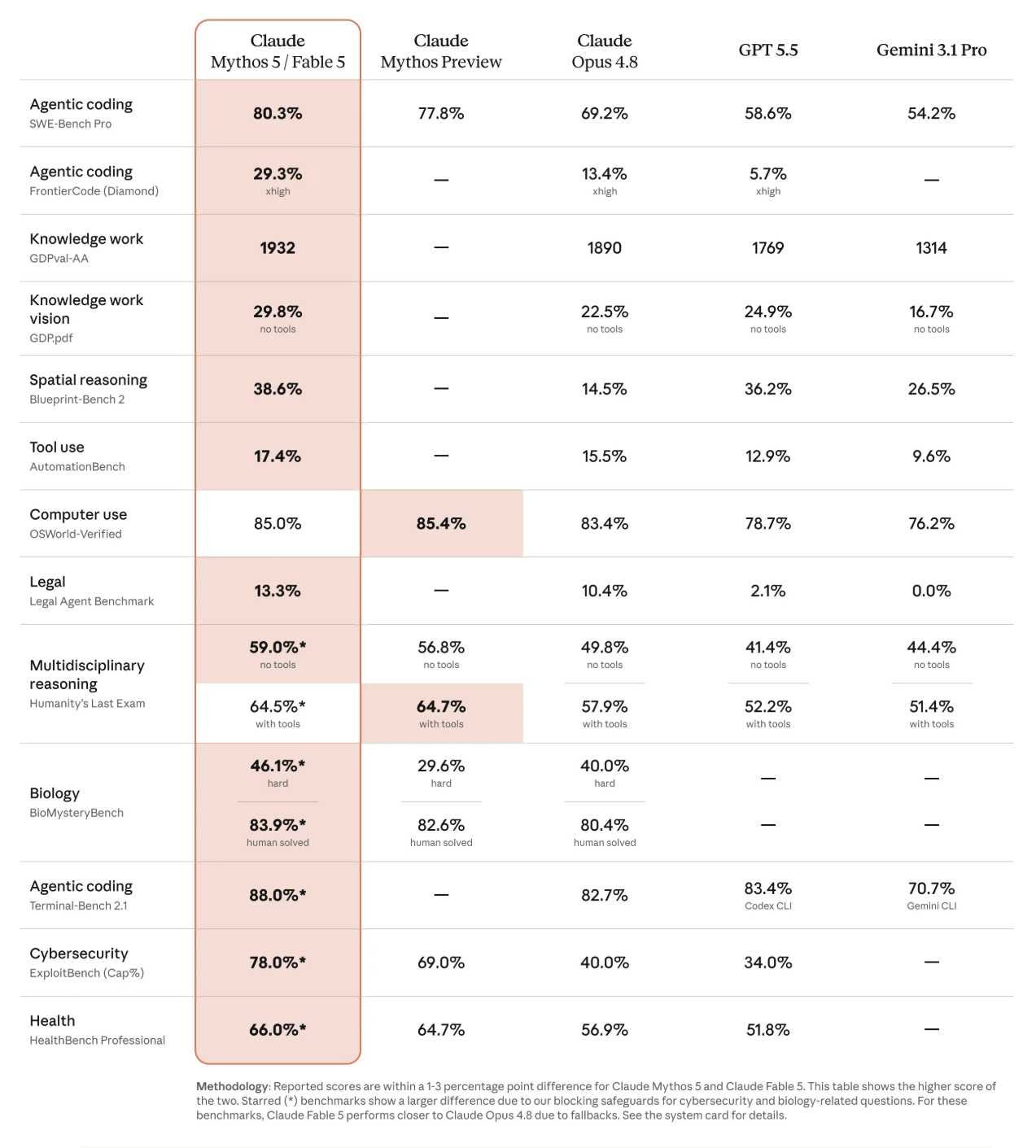
Anthropic has been using this expertise and focus to go big-game hunting for corporate money and, without revealing their books, it seems to have been effective, maybe too effective. A company reported burning through $500M in one month due to no Claude usage limits. On a related note, Uber burned through its entire annual agentic-coding budget by the end of Q1.
The benefits of signing up large corporate accounts early on are clear. Deep-pocketed clients can commit to longer and larger contracts than individual users. If Anthropic is successful, perhaps they become the Microsoft of AI with corporate leaders.
These deals come with some undesirable side effects, though. First, several corporate leaders have come out loudly and proudly declaring that they are cutting staff due to AI. So even if Anthropic is immediately benefiting from lavish contracts, the entire space is suffering from what I would call a bit of a PR crisis as the revolt against AI grows ever louder.
The second, somewhat related issue stems from the sales pitch Anthropic’s sales team needed to deliver to land these contracts. Presumably, to codify any sort of commitment, the sales team had to promise some sort of productivity return. Again, Uber COO Andrew Macdonald was cited as saying, “If you’re not actually able to draw a direct line to how much useful features and functionality you’re shipping to your users, that trade becomes harder to justify.”
For me personally, aside from my work at Group Table, AI has sped along several tasks, but it hasn’t outright upended the existing pipelines, at least not yet. The deltas between the numbers laid off, the gains in productivity, and costs associated with those gains are significant. In my contracting work as a product designer, I’m attempting to preach the importance of managing token burn and building efficient workflows and pipelines, which seems to have caught on as token-maxxing appears to be dying off.
As for the company specifically, Anthropic did a bit of a road show, wooing/scaring the geriatrics in Washington with its new Mythos/Fable model. It could be debated how wise it is to brand your own foundational model as “dangerous.” Certainly, this is a PR play; it all is. These are LLMs supported by machine learning at the end of the day, and the whole Wizard of Oz effect can seem outsized in a country that doesn’t take cybersecurity seriously and doesn’t seem like it could if it tried, at least not with the people who currently occupy office.
As of writing this, Anthropic has been forced to roll back the model again, perhaps part of the PR, perhaps the PR backfiring. It’s really so hard to say with the IPO theater that goes on and in this political environment. Truly, anything is possible. That said, needing to roll back a just-released model isn’t a great look, no matter how “dangerous” it is.
All this is to say, with an alienated public due to the PR disaster surrounding “restructuring around AI” and these contracts expiring due to lackluster returns on productivity, I wouldn’t be at all surprised to see some level of pullback at some point for Anthropic. That’s not to say that AI can’t and won’t become a permanent part of workplace culture. In fact, I think it already has. It’s just that the hype and the narrative have gotten ahead of the tech by a large margin.
Is the Window Closing for OpenAI?
Two years ago, the world was declaring OpenAI and ChatGPT the undisputed winners of the AI race. Now it’s looking like the company is in serious trouble, and it has nothing to do with Elon Musk’s lawsuit, though that probably didn’t help anything.
No, a series of unforced errors and strategic missteps have put the company in a difficult position as it helplessly sets money on fire. The company plans to burn through $115 billion through 2029, which was reported last year under rosier conditions.
Since then, the company has released minor improvements to their models to mixed results. Bringing on Jony Ive hasn’t seemed to have helped the company change its fortunes, at least not yet. There was a minor revolt this year when an estimated 2.5 million users unsubscribed from the platform because the COO donated funds to conservative efforts and, by proxy, ICE.
My personal experience as a user is that the product has lost its edge. ChatGPT 4.0 was pointed and would work toward an answer, a solution. Then the subsequent models started aiming toward the middle, regressing to the mean. It seemed like the team was attempting to appeal to everyone and ended up making a product for no one. Now today, the product does this weird, annoying both-sides-ism on literally everything. I’ve formed a habit of turning to ChatGPT, and I keep forgetting how annoying it’s become because it refuses to give me a concrete answer when I’m looking for one. It just gives me both sides and questions me at every turn. It’s not working toward an answer; it’s working toward engagement.
I posted on LinkedIn a couple of months ago in response to a video that was circulating that showed ChatGPT hallucinating a timer result. The original video went viral as “proof” that LLMs “suck” and aren’t ready for showtime. It was evidence of the latter more than the former. My post focused on something I continue to try to stress when people are getting angry about AI: these things aren’t magic; they’re interfaces. In this case, the interface wasn’t hooked up to anything. Unlike deterministic programming that errors out when there should be a dead end, LLMs hallucinate, and that’s what happened here.
Back to the business, though. So awkwardly, in November of 2025, OpenAI’s CFO said an IPO is “not on the cards right now.” Then, in April, it was reported that OpenAI’s CFO and Altman don’t see eye to eye on when to IPO. Then, on June 8th, OpenAI filed to go public. I think it goes without saying that none of this sounds promising at all. As an outside observer, the behaviors don’t suggest a company trying to maximize value, growing every quarter. It feels like a company that’s trying to find an exit. The recent activity with private equity doesn’t instill confidence either. PE has become the death knell of companies, not the harbinger of good things.
Update June 16, 2026: Today it was reported by Tech Crunch that Chat GPT’s market share had fallen below 50% for the first time ever, somewhat confirming the assumptions in this article.
Perplexity and 2028
Perpetually marching to the beat of its own drummer and really in a different league from these foundational models is Perplexity. Being that Perplexity is in the application layer, it makes sense that it would come later.
This isn’t really a statement about Perplexity per se. I don’t know their business model, token consumption, efficiencies, and whatnot, but this is such an important aspect of the AI economy: the applications that are spawned from the foundational models of GenAI.
So, as you may have guessed from my piece, I think these IPOs are premature, but I also don’t think that will matter. There will be pullback and maybe some consolidation, but in the long run, I think this space will thrive. The companies like Perplexity, the companies that develop on these models and find ways to bring the technology to consumers, will create this AI economy, not Anthropic or OpenAI.
However, that hasn’t happened yet, so we have this tension, this angst, and anger. I often cite a fact about the Industrial Revolution, that the Industrial Revolution, specifically textile mills led to job loss initially, but ultimately it led to a fifty-fold increase in productivity.
Now I have to be very honest about that statement. Job loss is real, and it hurts. I’ve experienced it while trying to support a family, and I still haven’t moved on from it emotionally. Also, productivity is a slippery term. Productivity, especially in an AI economy, might not mean jobs, though I ultimately think it will as we introduce more robotics, channels, and ways of doing things.
I don’t know if I’ll be right about AI and the future. I hope I am, but it’s incredibly hard to say. All I know is some very rich and powerful people will be even richer and more powerful after this while we all look on and wonder if the bet they made for all of us will be worth it.